Engineering drawing outsourcing gives engineering firms more production capacity without adding pressure to their local teams. But when drawings fall short of technical requirements, client standards or local documentation expectations, the pressure lands right back on those teams.
Successful outsourcing therefore depends on more than drafting capacity. It requires a consistent quality assurance (QA) process that carries client requirements through every stage of production. This becomes more important when supporting projects across the US and Australia, where codes, drawing conventions and documentation requirements differ.
Key takeaways
QA works best when it’s built into each stage of drawing production, so issues are resolved where they start.
The QA process stays the same in every market, while the codes and conventions it checks against are set for each project.
A dedicated team learns each client’s standards over time, which reduces repeat corrections and improves first-pass drawing quality.
Why quality control matters in engineering drawing outsourcing
Engineering drawings communicate design intent to consultants, contractors and approving authorities, so an error on one sheet carries through the rest of the project. Common issues in outsourced drawing production include:
Inconsistent detailing across drawing sets
Incorrect dimensions or annotations
Drawings that don’t match the engineering calculations
Outdated templates or client standards
Coordination gaps between sheets and disciplines
Most of these issues arise when QA is treated as a final check before submission. Instead, quality checks need to be built into the production workflow, with clear responsibility for identifying and resolving issues at each stage. This helps outsourced drawing production function as an extension of the client’s internal engineering team, rather than creating another layer of checking for its senior engineers.
Build the QA process around each client’s drawing standards
No single drawing standard works for every engineering client, so the dedicated team defines the requirements before production begins:
Drawing templates and title blocks
Layering and file standards
Annotation and dimension conventions
Preferred structural details
Calculation and drawing coordination requirements
Naming and revision conventions
Project-specific codes and standards
Previously approved projects serve as benchmarks where available. These requirements then go into a client- or project-specific drawing checklist, giving the team one consistent reference throughout production. This checklist is established during project onboarding and maintained as an internal reference, so the team can apply the same requirements consistently across drawing packages and future projects.
Build QA into the engineering drawing workflow
Engineers check their own work first
Self-checking is the first QA layer. Before formal review, engineers and drafters check dimensions, notes, references, sections, details and coordination between sheets. They also confirm that each drawing reflects the latest engineering information and project revisions. Structured checklists help identify recurring errors early, before they move into the next review stage.
Add peer and senior review
Drawings then move through peer or senior technical review, which checks both technical accuracy and alignment with the client’s drafting and documentation standards.
Complex or higher-risk structural elements may require additional review. Review comments are assigned to the relevant team members, ensuring each issue has clear ownership and is resolved before release.
Track and close QA comments
Markups, review comments and revisions are recorded, and each issue is confirmed as resolved before drawings progress to the next stage.
A final review checks drawing consistency, revision status, file naming and documentation completeness. This creates a traceable QA process, with a clear record of what was reviewed, what needed correction and how each issue was closed out.
How drawing QA changes between countries
The QA workflow stays the same in every market. What changes is the technical criteria it checks against, which depend on where the project is located.
United States
Australia
Building codes
International Building Code (IBC), adopted and amended by state and local jurisdictions
National Construction Code (NCC) and Australian Standards
Units
Imperial
Metric
Documentation terms
Construction documents, permit sets
Construction Certificate (CC), Issued for Construction (IFC)
Approval requirements
Set by the local authority having jurisdiction
Set by the relevant state and certifying authority
US projects may involve different jurisdictional requirements and structural standards depending on their location. Australian projects must account for the applicable NCC requirements, Australian Standards and client-specific documentation practices.
Terminology, drawing conventions and submission expectations also vary between projects. The dedicated team therefore establishes the applicable requirements during project setup rather than applying one global checklist.
The process stays standardized, while the engineering criteria stay project-specific.
How dedicated teams improve outsourced drawing quality over time
This is where the dedicated team model makes the biggest difference. Because the same engineers work on the client’s projects, they build familiarity with its:
Drawing standards and preferred details
Structural systems
Software workflows
Review expectations and recurring project requirements
That knowledge carries forward instead of being lost between individual outsourced engagements. Feedback from each project can be incorporated into future checklists, templates and team training. Team Leaders track recurring review comments and address them at process level. New team members are onboarded against established client-specific standards rather than starting from generic drafting instructions.
The result is fewer repeated corrections and stronger first-pass alignment. As an example, Away Digital’s dedicated team supported a national MEP engineering firm on data center projects, delivering a material reduction in RFI volume and measurable improvement in first-pass documentation quality. By the third project, the team was identifying coordination issues before the firm’s own engineers raised them. The same approach applies across project types, from data centers to MEP documentation for tunnel infrastructure.
Add capacity without adding QA work
Engineering drawing outsourcing should increase capacity without creating extra checking work for the client’s internal team. A structured QA framework, paired with a dedicated team that learns the client’s standards, makes drawing quality more consistent and predictable from one project to the next.
Away Digital builds dedicated engineering teams around standardized QA workflows, client-specific requirements and continuous improvement across long-term partnerships. See how our engineering drafting teams work.
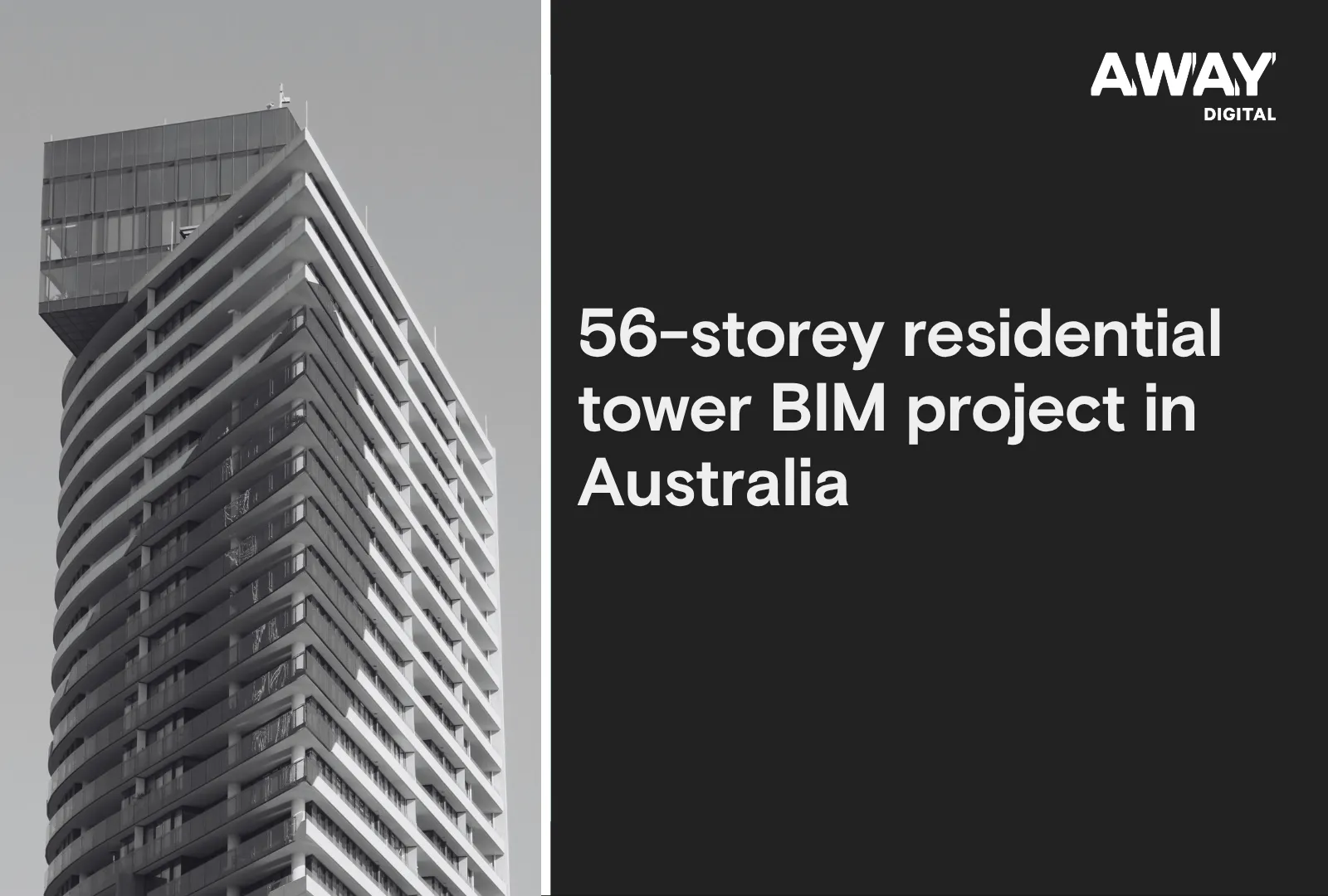
PROJECT SNAPSHOT Away Digital supported the delivery of a complex 56-storey residential tower in Australia, providing Revit modeling, service coordination, detailing and documentation across the residential tower and podium. The project required close coordination across multiple floors, structural elements and MEP systems. A cloud-based BIM 360 / ACC workspace and consistent coordination protocols helped keep […]
Developers need architecture and engineering partners who can deliver coordinated, buildable documentation to schedule. When production capacity falls short, drawing packages take longer, coordination issues remain unresolved and dependent project activities can be delayed. For architecture and engineering firms, reliable delivery capacity affects both client retention and the ability to take on new work. Firms […]
PROJECT SNAPSHOT A national consulting engineering firm working across structural, civil and MEP disciplines, with a growing concentration of hyperscale and enterprise data center work. As clients awarded larger packages and expected faster turnarounds, the firm needed additional capacity so its engineers could stay focused on design and client-facing work. Away Digital built a dedicated […]
LET’S TALK
Subscribe to monthly newsletter
Sign up to receive a monthly email on the latest updates, features, and news!