

Your Guide to Getting Outsourcing Right the First Time


Ask any AEC leader what they fear most when outsourcing and “inconsistent quality” will be near the top of the list.
It’s a valid concern. When work is being delivered offshore, across time zones, and at scale, there’s a lot that can go wrong. Communication gaps, misaligned expectations and unclear standards are all friction points that can quickly turn into risk.
At Away Digital, we’ve delivered more than 600 commercial projects and over 15,000 residential homes through our offshore teams in Vietnam. And while those numbers might sound impressive on their own, the real insight comes from what it takes to do that work consistently, and well.
Because quality at scale isn’t a promise. It’s a process. And it’s one we’ve spent more than a decade refining.
Delivering thousands of homes or hundreds of retail stores isn’t just about headcount, it’s about systems.
Volume reveals everything: gaps in documentation, inefficiencies in workflow, breakdowns in communication. It exposes where your quality control actually sits (and where it doesn’t), how well your teams handle feedback, and how scalable your delivery model really is.
What those 15,000+ homes have taught us isn’t how to work faster, it’s how to work cleaner. How to build repeatable QA processes. How to onboard team members into a client’s standards quickly. How to ensure continuity even when projects scale up unexpectedly or team members shift.
It’s not about doing the same job 15,000 times. It’s about doing 15,000 versions of the job, each one tailored to a different client, brief, and set of standards without letting quality drop. That’s where the real learning lives.
We don’t sell quality. We build for it.
Consistency across offshore teams doesn’t happen by chance, it happens by design. That means developing structured handover templates, shared delivery checklists, QA pipelines, and daily review loops. It means every team member knows not only what to deliver but how it should be delivered and why it matters.
One of the biggest lessons we’ve learned is that inconsistency rarely starts in production. It usually starts in briefing. Or onboarding. Or unclear expectations that trickle into downstream work.
To combat that, we’ve built a thorough onboarding process unique to every client. On top of this, we follow systems that mirror top AEC firms globally:
Because when the work is moving fast, you can’t rely on memory or intent. You need structure.
Some of our biggest process breakthroughs didn’t come from ideal projects, they came from the difficult ones.
One client, a national retail chain with a fast-paced store rollout schedule, came to us frustrated by their previous outsourcing experience. Too many people had touched the same files. Documentation varied store-to-store. Delivery timeframes kept slipping. They didn’t need more output, they needed control.
We didn’t throw more people at the problem. We embedded a team who worked exclusively on their account, mirrored their internal QA structure, and mapped every standard into a custom onboarding pack for new team members. Within months, drawing variations dropped, review time halved, and delivery confidence returned.
In another case, a volume builder asked us to take on overflow drafting. But they hadn’t expected the complexity of translating their internal processes into offshore delivery. What started as a trial for overflow work turned into a full integrated documentation team, complete with daily standups, Slack channels, and direct collaboration with their local design managers.
These aren’t plug-and-play relationships. They’re built carefully. Iteratively. With real investment from both sides. But when done right, they create a foundation for scale that doesn’t buckle under pressure.

Scaling AEC delivery is not about adding more people, it’s about building the right team in the right structure, for the right type of work.
That might sound obvious, but it’s where many outsourcing models fall apart. Too often, firms approach offshore support as if it’s a volume exercise, treating specialist technical roles like generic, interchangeable labor. But in AEC, success isn’t about how many drawings you can push through a system but about how consistently those drawings reflect your standards, your methodology, and your expectations.
That’s why plug-and-play outsourcing doesn’t work in this sector. You’re not handing over a repetitive task with one fixed output. You’re collaborating on documentation, modeling, estimation, or visualisation — each with nuanced workflows, live feedback cycles, and evolving standards depending on the client, the project stage, or the jurisdiction.
It’s not just technical, it’s contextual. And building for scale in that environment requires a fundamentally different approach.
The first step is acknowledging that AEC isn’t one-size-fits-all. A team doing BIM modeling for mid-rise residential developments in Victoria will need different domain understanding and deliverables than a team producing retail documentation in Queensland or office fit-outs in the US. That’s why at Away Digital, we never treat scaling as a templated process. Every dedicated team we build is purpose-fit for the sector, project type, and regional context of the client.
This also means prioritising deep technical alignment over surface-level skillsets. We don’t just ask if someone knows Revit or AutoCAD, we look at whether they understand your version of those tools. Have they worked in your construction code environment before? Are they familiar with your layering, annotation, or naming conventions? Can they mirror the logic your internal team uses to navigate drawing sets, track revisions, or communicate markups?
When the answer is yes, scale becomes seamless. Your offshore team doesn’t just deliver, they integrate. They adapt to your workflow instead of forcing you to adapt to theirs. And over time, they become an extension of your internal capability and not just an overflow resource.
Equally critical is building institutional knowledge into the team. Scaling without structure results in churn. Knowledge gets lost between projects or team members, and that’s where errors creep in. We’ve solved this by building shared onboarding packs, client-specific training frameworks, and internal documentation libraries that ensure consistency across every person who touches a file. So when you scale, you’re not just adding headcount, you’re scaling a system that already understands how you work.
And finally, scale has to be resilient. People move. Projects spike. Standards evolve. So we structure teams in a way that creates flexibility without compromising stability, backfilling proactively, embedding team leads who can maintain quality under pressure, and structuring feedback systems that catch drift before it becomes risk.
This is what real scale looks like in AEC. Not just output but operational maturity, repeatability, and the kind of contextual understanding that can only be built, not bought.
If there’s one thing we’ve learned after more than a decade of building offshore AEC teams, it’s this:
Quality doesn’t scale because you hope it will. It scales because you’ve built the systems, selected the right people, and created a feedback loop strong enough to keep standards in check, project after project.
The best outsourcing models aren’t based on price. They’re built around consistency, communication, and the ability to keep delivering without burning out your local team or compromising on quality.
That’s not something you can bolt on. It has to be built in.
And once it is, it changes everything.
If outsourcing has been something your business has considered for a while, why not check out what pulling the trigger can really do for your business in our blog: “Why waiting to outsource might be the most expensive decision you make”.

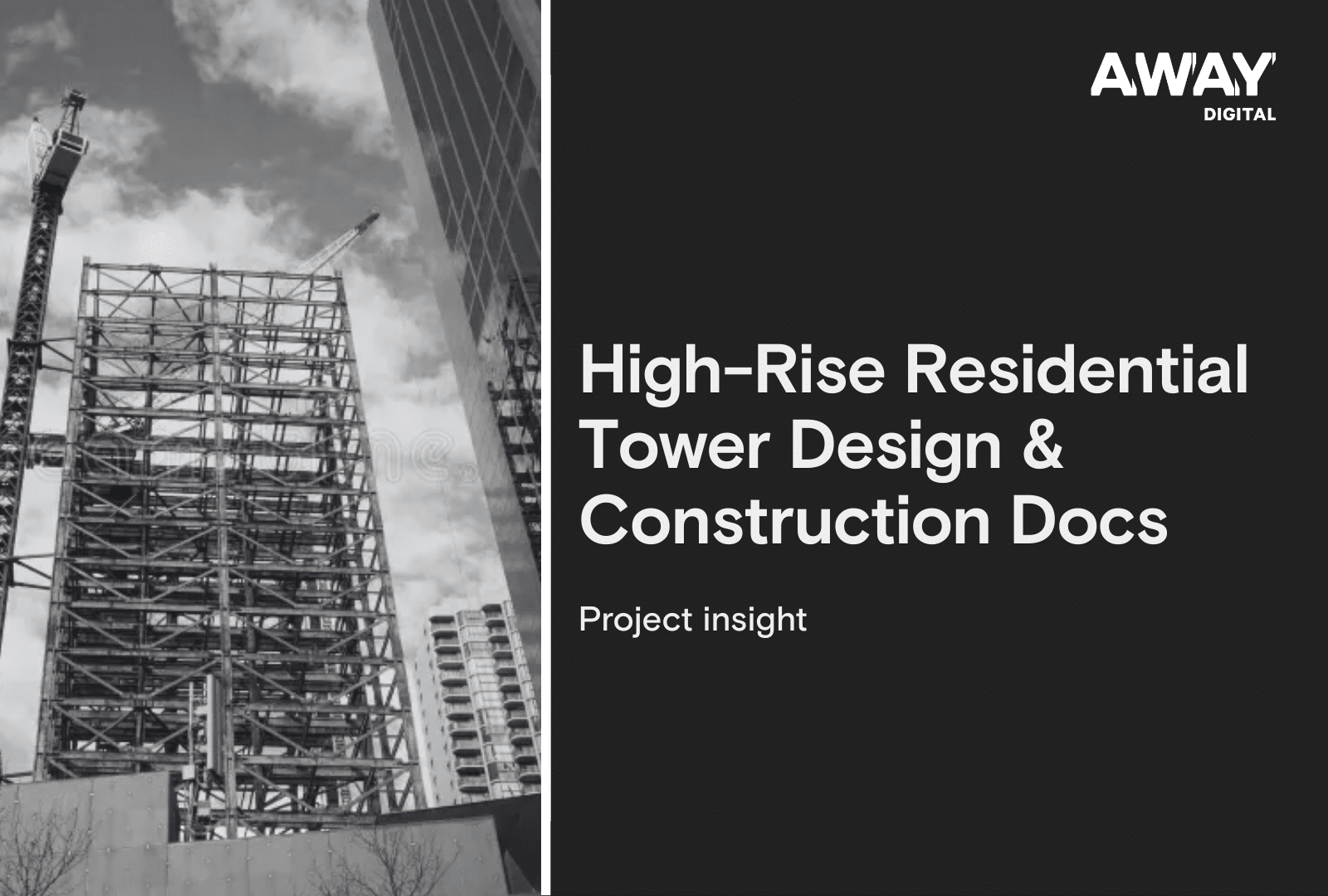
Project snapshot A 55+-storey residential tower in Australia requiring full DD and construction documentation. Away Digital supported the project from model development through to final façade detailing and coordinated service drawings. Project overview Location: AustraliaSector: Student accommodationDuration: 2 years 3 months Scope of work Project stage: Design development and construction drawing packagesScale: 55+-storey tower with […]
Sign up to receive a monthly email on the latest updates, features, and news!
